Education
Introducing the Qualitrix T.R.U.S.T.™ Framework: A New Blueprint for Trusted Digital & AI Systems

For more than two decades, software quality engineering has revolved around one fundamental question:
Does the software work as intended?
Organizations invested heavily in functional testing, automation, performance engineering, security testing, and release validation to answer that question with confidence. This approach worked well for the industry throughout the era of digital transformation.
But Artificial Intelligence has fundamentally changed software.
Modern systems no longer follow only fixed rules. They learn from data and create new content. They can understand different contexts, make recommendations, and work through autonomous agents. They also keep changing over time and are increasingly making decisions that were once made by humans.
The question organizations must answer today is no longer merely:
“Does it work?”
Instead, they must answer important question:
“Can we trust it?”
That single shift changes everything.
Welcome to the era where Trust becomes the new definition of Quality.
Traditional Quality Engineering focused on validating software outputs. AI introduces an entirely different class of challenges. Today’s organizations must answer questions that never existed before.
These are no longer traditional testing problems. They are Trust Engineering problems. Trust Engineering is the discipline of ensuring that digital and AI systems remain accurate, reliable, observable, secure, responsible, user-centric and continuously improving throughout their lifecycle.
At Qualitrix, we believe this represents the next evolution of Quality Engineering.
One common misconception is that AI quality is only about testing AI-powered applications. In reality, AI now exists across the entire technology ecosystem.
After working with organizations across banking, healthcare, retail, communications, government, AI startups, and digital platforms, we have seen a common challenge.
Organizations face trust challenges at three different levels. Each level has its own challenges. Each level also needs a different testing and validation approach.
Perhaps the biggest change happening today is not in the software being built. It is in how software is being built. Development teams are increasingly using AI across the Software Development Lifecycle.
AI now helps engineers:
This new approach is often called AI-Led Software Engineering. It can greatly improve productivity. However, it also brings a new set of quality challenges.
Not all human-designed AI agents have the same capabilities. One coding agent may work like an experienced software architect. Another may work like a junior developer. A third may create code that runs correctly but has poor design or security issues. Simply creating working code is no longer enough.
Organizations must evaluate whether AI systems are:
Even human developers now need new ways to check their work. Prompt engineering has become an important engineering skill. Poor prompts can lead to poor software, even when using advanced AI models. AI-generated code may also create problems. It may pass compilation but still have unnecessary complexity, repeated code, hidden security risks, or maintenance issues in the future.
The goal is not just to test the software. It is to validate the entire AI-enabled engineering ecosystem. Within the Qualitrix T.R.U.S.T.™ Framework, this layer focuses mainly on:
One of the key principles we recommend is Test-Driven Development (TDD).
Organizations should not treat AI-generated output as final. Instead, they should create continuous testing and review loops. AI-generated work should be tested, reviewed, improved, and tested again before it reaches production.
The future of software engineering will not depend only on how much AI we use. It will depend on how well we check and manage AI’s contribution to software development.
The second layer is where AI becomes an integral part of the digital products and platforms that the millions of users interact with every day.
Across industries, AI is no longer a standalone tool. It is now part of the core customer experience and business operations.
In all these industries, AI is no longer just an extra feature. It has become part of the mission-critical digital ecosystem.
Traditional software usually follows fixed rules and produces predictable results. AI-enabled systems can work differently. Their results can depend on AI models, business data, retrieval methods, prompts, memory, business rules, user information, continuous learning, and interactions with other AI agents.
As these systems become more advanced, building trust becomes more complex. Testing basic functions alone is no longer enough.
Organizations must evaluate AI-enabled systems across several areas, including:
However, testing should not stop after the application goes live. AI-enabled systems keep changing. AI models can change over time. Business data can change. Customer behavior can shift. Regulations can also change. New business needs can appear.
For example, a banking assistant may work well today but give incorrect answers after a policy update. A retail recommendation system may become less useful as customer preferences change. A fraud detection model may become less effective as fraud methods change.
Trust must therefore be maintained continuously. It cannot depend on a one-time testing process.
Organizations need ongoing processes for:
This is where the complete Qualitrix T.R.U.S.T.™ Framework comes together.
It combines autonomous validation, reliability engineering, user-focused testing, security, governance, and continuous data and model improvement. This helps organizations move beyond simply launching AI-enabled applications. It helps them build digital systems that users, businesses, and regulators can trust.
A third category receives far less attention but is equally important. Thousands of organizations today are building AI solutions on top of:
These organizations form the foundation of the global AI ecosystem. If these platforms are not reliable, every downstream application inherits those weaknesses. Validation at this level requires significantly different expertise.
Organizations building foundational AI platforms must evaluate:
Supporting this layer enables confidence not just in one application – but across thousands of downstream AI solutions. As AI ecosystems mature, Trust Engineering must extend from applications all the way to foundational AI platforms.
Working with global enterprises, digital-native companies, financial institutions, governments and AI innovators, we noticed something fascinating. Every organization was solving different problems. Yet every executive was ultimately asking the same question.
That realization led us to develop the Qualitrix T.R.U.S.T.™ Framework.
At Qualitrix, we believe Trust isn’t achieved through a single test, tool, or model. It is engineered across five interconnected dimensions, captured in our T.R.U.S.T.™ Framework.
It is not another testing methodology. It is not a replacement for existing quality engineering practices. Instead, it provides a whole blueprint for engineering trust across modern Digital and AI ecosystems.
T.R.U.S.T.™ – Engineering Trust Across Digital & AI Systems
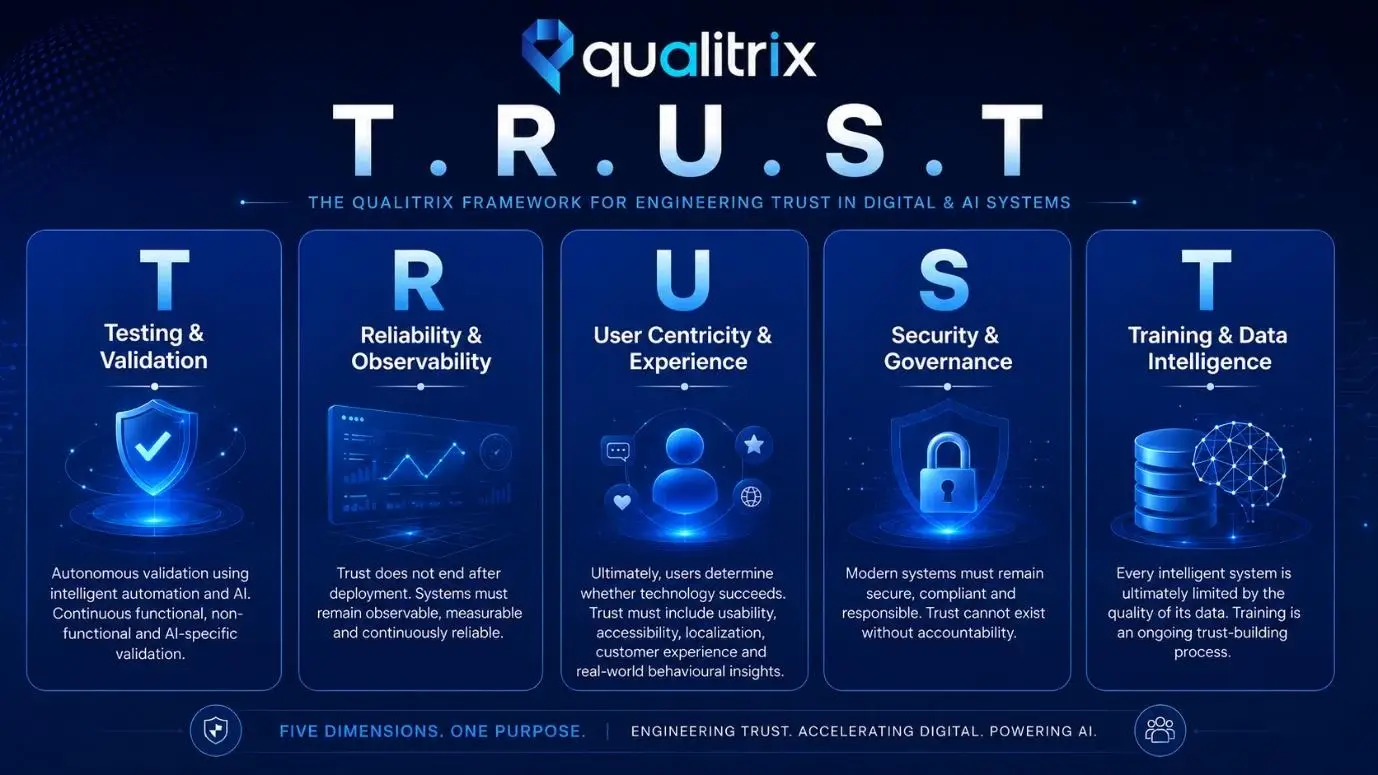
Modern digital and AI systems can no longer depend on periodic testing or only manual checks. AI is now part of software development and application processes. As a result, testing must also become more advanced. It needs to be continuous, automated, and intelligent.
Organizations need to move beyond traditional test automation. They need AI-native validation that continuously checks software quality, AI behavior, autonomous agents, and AI-generated results. This allows them to keep up with the speed of modern software development.
At Qualitrix, this approach is supported by our AI-native engineering ecosystem. It includes AI Infinitum, Nogrunt, and AI Studio. Together, these solutions support autonomous testing, agent-based quality engineering, AI-assisted Test-Driven Development (TDD), and smart validation tools. They help organizations build trust into every software release.
Trust is not built when an application is launched. It is earned every day in production. Modern digital and AI systems need continuous visibility. Organizations must be able to track application health, AI behavior, model performance, changes in data, and business results. They need to go beyond basic monitoring. They need continuous Trust Engineering. This approach helps teams find, understand, and fix problems before they affect users.
The Qualitrix approach brings together AI monitoring, production insights, model health checks, drift detection, bias checks, and reliability engineering. Nogrunt supports synthetic monitoring and proactive testing. Oprimes provides real-user monitoring and insights into the production experience. Together, these solutions give enterprises a clear view of both system health and its impact on users.
The true measure of trust is not just technical accuracy. It is how confidently users can use and depend on a system. Organizations need continuous insight into real user experiences. This helps ensure that digital and AI systems remain easy to use, accessible, useful, and aligned with changing customer needs.
This is where Oprimes provides a strong advantage. Its Human Intelligence Platform has a user base of more than 10 million people. It helps enterprises test real user journeys and find problems in the user experience.
It also helps organizations:
These real-user insights help organizations build digital and AI experiences that users can trust.
As digital and AI systems become more independent, strong security and governance become more important. Organizations must test more than whether a system works correctly. They must also check whether it is secure, ethical, and follows set rules. This is especially important when systems face attacks or harmful inputs.
Organizations need capabilities such as:
We include these capabilities across the engineering lifecycle. Our approach combines AI governance, security engineering, and Responsible AI testing. This helps organizations adopt AI faster while maintaining strong security and trust.
Every AI system is only as reliable as the data used to build and improve it. Trusted AI requires ongoing work with data. This includes collecting, organizing, labeling, checking, and improving data. It also includes learning from user preferences and updating models as business needs change.
Organizations need scalable ways to improve both data and AI models throughout the AI lifecycle. This work should not stop after the initial training stage.
Through Oprimes, Qualitrix has built a global human intelligence network with more than 10 million contributors across 130 countries and 40+ major languages. This network helps enterprises collect, organize, label, and check high-quality data. It also helps bring real human preferences and production insights into ongoing model improvement.
A framework is useful only when organizations can put it into practice. The Qualitrix T.R.U.S.T.™ Framework is supported by a purpose-built ecosystem of AI-native platforms, human intelligence, and engineering solutions. This ecosystem helps enterprises build, test, monitor, and continuously improve trusted digital and AI systems.
Together, these capabilities form an integrated Trust Engineering ecosystem that enables organizations to build trusted AI-led engineering processes, AI-enabled digital products, and foundational AI platforms.
Artificial Intelligence will continue transforming software engineering at an unprecedented pace.
And in that future, testing alone will no longer differentiate successful organizations. Trust will!
Organizations that systematically engineer trust will innovate faster, deploy with greater confidence, reduce business risk, improve customer adoption and build stronger digital brands. The future of Quality Engineering is no longer about verifying software after it is built. It is about continuously engineering confidence throughout the lifecycle of digital and AI systems.
That is the philosophy behind the Qualitrix T.R.U.S.T.™ Framework.
It represents our belief that quality has evolved beyond defect detection. It has become the discipline of creating systems that organizations, regulators, developers and users can confidently trust.
As AI reshapes every industry, the winners will not simply be those who build intelligent systems.
They will be those who build trusted intelligent systems.
At Qualitrix, we are excited to help shape that future. Because in the age of autonomous software, Trust is the new Quality.

Future Begins With Trust
A 30-minute conversation with an engineer who has done this before — not a sales call. We will tell you what we would do differently, whether or not you work with us.