General
A Complete Guide to API Security Testing for Enterprises
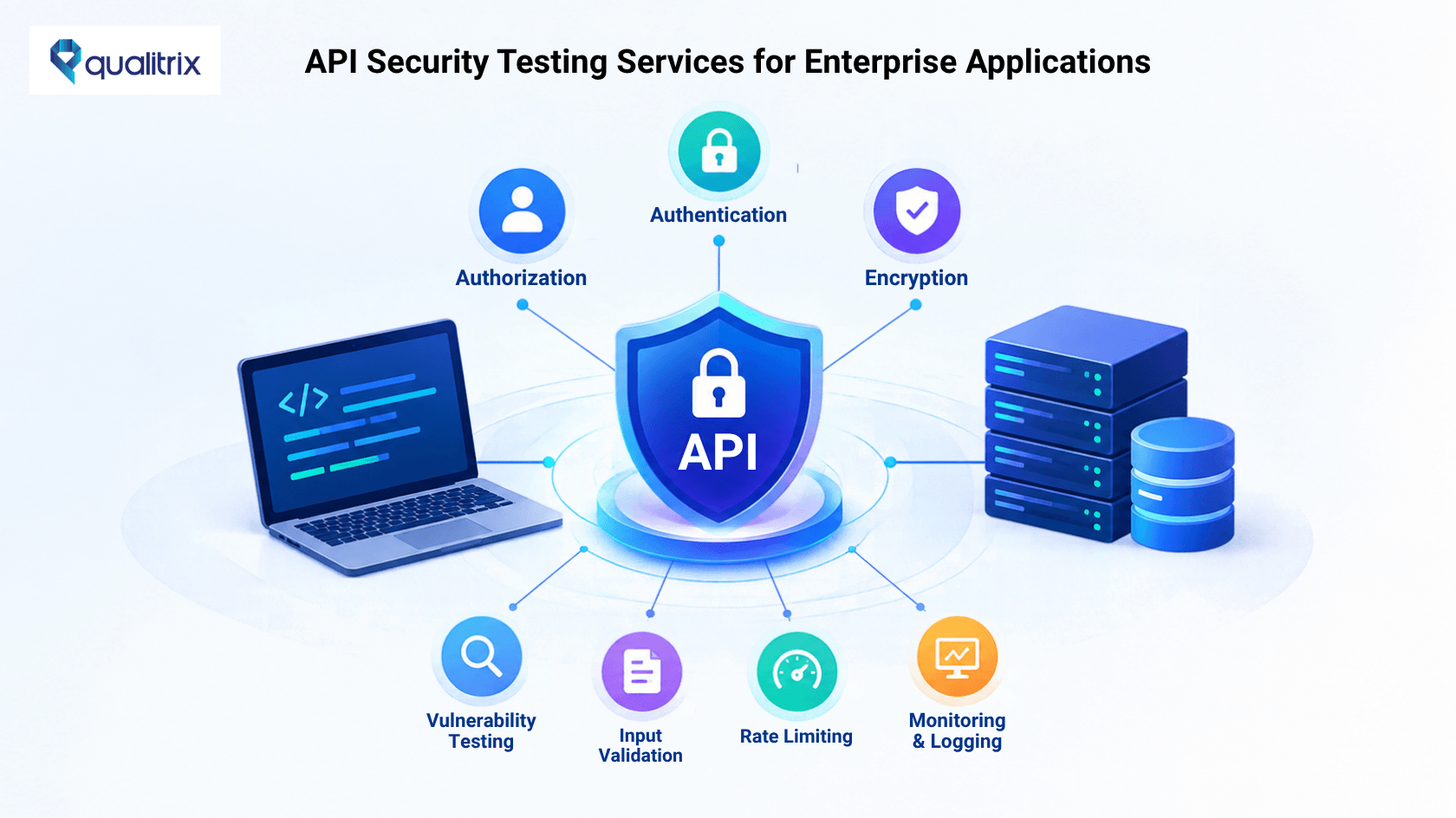

Enterprise applications rarely work alone. They connect to payment platforms, customer databases, mobile apps, cloud services, third-party systems, and internal tools through APIs.
As the number of APIs grows, so does the risk. Weak authentication, excessive data sharing, or poor access control can expose sensitive information. These issues can also disrupt business operations.
This is why API security testing services are important. API security testing helps organizations find vulnerabilities, check access controls, test how APIs respond to inputs, and protect sensitive data before issues reach production. Regular testing also helps teams include security in the software development lifecycle, rather than making it a final step.
API security testing is the process of checking APIs for vulnerabilities, security flaws, and incorrect behavior that unauthorized users could exploit.
An API security test can look at authentication, authorization, input validation, data exposure, encryption, rate limiting, error handling, and business logic. Testing can use both automated tools and manual security reviews.
For enterprise applications, the scope is often wider. APIs may connect systems and handle sensitive data like customer records, financial transactions, employee data, or business-critical operations.
API security testing must go beyond checking whether an API returns the expected response. It must also check how the API behaves when users send unauthorized or malicious requests.
Testing can include reviewing API specifications, mapping endpoints, sending malformed requests, and analyzing responses for security weaknesses.
APIs act as the bridge between the user interface and critical backend systems. They may also connect services with external platforms.
This makes an API vulnerability more than a technical problem. It can affect customer data, business transactions, application availability, and compliance with regulations.
Imagine an enterprise application that exposes customer account information through an API. If authorization is not set up correctly, one authenticated user might be able to access another user account. Similarly, an API that does not properly validate inputs may fall victim to injection attacks.
Common API security risks include:
A strong testing strategy should consider these risks throughout development, deployment, and production monitoring.
The OWASP API Security Top 10 is also helpful for organizing security testing around API risk areas. Testing teams can use it as a reference when designing security scenarios and reviewing API controls.
API security testing requires more than just scanning an endpoint for known vulnerabilities. Enterprise teams need to test how the API behaves under access conditions and inputs.
Authentication testing checks whether the API correctly verifies user or service identity.
Authorization testing goes further. It checks whether an authenticated user can access the resources and actions that are allowed for them.
Testing should include roles, permissions, tokens, and access scenarios. It should also check whether expired, invalid, or manipulated credentials are rejected.
APIs accept parameters, headers, query values, and request bodies from clients. These inputs should be checked before they are processed.
Testing can use malformed or malicious inputs to find weaknesses that could lead to injection attacks or other unwanted behavior.
Fuzz testing is one method that helps to identify how an API responds to inputs. API security testing tools may automate these tests by generating and sending request variations.
APIs should return the information needed for a specific operation.
Security testing should examine API responses for sensitive data. This can include information, internal identifiers, authentication details, or business data that should not be shared with a particular user.
An API that allows unlimited requests can be exposed to abuse or denial-of-service attacks.
Testing should verify whether rate limits and throttling controls work as expected. Teams should also check how the API behaves when request volumes increase quickly.
Configuration issues can create vulnerabilities even if the application code is secure.
Testing should review HTTPS enforcement, security headers, error messages, authentication settings, exposed endpoints, and other configuration areas.
Not every API vulnerability comes from a coding error. Some happen in the way business rules are implemented.
For example, an API may correctly authenticate a user. Still allow a sequence of valid requests that bypass an important business rule.
This is why manual testing remains important alongside automated security testing.
A practical API security testing process usually begins with API discovery and documentation review.
Teams first identify the APIs that need to be tested. OpenAPI specifications, API documentation, application architecture, and existing test assets can help create an inventory.
The next step is to understand expected API behavior. Testers can then create scenarios covering authentication, authorization, input validation, data exposure, rate limiting, and other security needs.
Automated tools can send HTTP requests. Analyze API responses. They can also support vulnerability scanning, fuzzing, static analysis, dynamic testing, and runtime monitoring.
Manual testing adds another layer of coverage. Security professionals can investigate business logic, unusual attack paths, and issues that automated tools may miss.
A mature approach combines both methods and integrates repeatable security tests into the development and CI/CD process.
The API security testing tools depend on the application architecture, testing needs, API technology, and security goals.
Common categories include API clients, vulnerability scanners, proxy-based security testing tools, fuzzing tools, SAST and DAST solutions, and API testing frameworks.
Tools such as Postman can support API development and automated testing. Burp Suite provides capabilities for intercepting and testing API requests. OWASP ZAP offers open-source options for automated and manual security testing. Other tools support security, performance, and continuous API testing.
When asking which are the best API security testing tools, enterprise teams should ask which capabilities match their environment.
Important evaluation factors include:
The tool should fit into the existing development and security workflow without creating another isolated testing process.
A practical API security testing checklist can help teams maintain coverage across releases.
Before an API reaches production, teams should consider whether they have:
This checklist should be adapted based on application risk, industry requirements, API architecture, and the sensitivity of the data being processed.
Security testing should not happen before a major release.
Modern enterprise applications can change often. APIs may be updated during a development cycle. A security test that was valid last month may not provide enough coverage after a major API change.
Teams can integrate automated API security tests into CI/CD pipelines so security checks run alongside automated tests.
For example, a pipeline can validate API authentication, authorization, input handling, and known security conditions after a build. Thorough security assessments can run at appropriate stages before production deployment.
This shift-left approach gives development and security teams visibility into vulnerabilities and reduces the chance of carrying unresolved security issues into later stages. Continuous testing also supports feedback as APIs evolve.
Enterprise API environments can become hard to manage as the number of endpoints, integrations, users, and business processes grows.
API security testing services can bring together automated scanning, manual security testing, vulnerability assessment, penetration testing, and continuous security validation.
This approach can help teams identify vulnerabilities earlier, improve security coverage, support compliance requirements, and reduce the risk of security issues reaching production.
Qualitrix combines automated security testing with hands-on testing across web, mobile, API, and cloud environments. Its security testing services include API security testing, vulnerability assessment, penetration testing, SAST/DAST, threat modeling, and CI/CD security integration.
For enterprise applications, the focus should be on building a security testing process that fits the application lifecycle and business risk.
APIs are central to modern enterprise applications. They connect systems, exchange data, and support critical business workflows. As API environments grow more complex, security testing needs to be a continuous part of the software quality and security strategy.
A strong API security testing approach combines automated testing, manual validation, risk-based coverage, and continuous testing. The right tools can improve testing efficiency, but effective API security also requires a clear understanding of business logic, access controls, data flows, and application risks.
If you need to strengthen the security of your enterprise APIs, our API security testing services combine automated and manual testing to identify vulnerabilities, validate security controls, and support more secure application releases.
Contact Qualitrix today to discuss your API security testing needs and build a stronger security strategy for your enterprise applications.
API security testing is the process of testing APIs for vulnerabilities, security misconfigurations, unauthorized access, data exposure, and other weaknesses that attackers could exploit. It involves sending invalid and potentially malicious requests to API endpoints and analyzing the responses. Testing can include DAST, fuzz testing, penetration testing, authentication and authorization testing, input validation, and automated security tests. The goal is to identify and fix security issues before they can affect enterprise applications or sensitive data.
There is no universal ranking of the top API security tools. Tool selection depends on the API architecture, testing requirements, development workflow, and security objectives. Used tools and platforms include:
These tools serve different purposes; enterprise teams may use multiple tools as part of a broader API security testing strategy.
Key API security practices include:
A combination of testing, automation, strong access controls, continuous monitoring, and regular security reviews can strengthen API protection.
Common API security vulnerabilities include authentication and authorization flaws, improper input validation, injection attacks, sensitive data exposure, security misconfigurations, rate limiting, and business logic flaws.
For example, weak authorization can allow a user to access another users data. Poor input validation can allow input to reach backend systems. Misconfigured APIs may expose information or functionality. APIs without appropriate rate limiting can also be abused through requests or denial-of-service attacks.
The three foundational areas of API security are authentication, authorization, and encryption.
These controls work together. They are not sufficient on their own. A mature API security program also needs vulnerability testing, input validation, rate limiting, API discovery, monitoring, secure development practices, and continuous security testing.

Future Begins With Trust
A 30-minute conversation with an engineer who has done this before — not a sales call. We will tell you what we would do differently, whether or not you work with us.