General
Build vs. Buy: In-House Automation Framework or AI-Powered Platform?

Quick answer: Build an in-house framework when your application is narrow, your engineering capacity is secure, and testing is a core internal capability. Buy an AI-powered platform when you need broad coverage quickly, lack senior automation talent, or run many releases across web, mobile, and APIs. Most enterprises land on a hybrid approach, pairing a platform with selective custom code and, when capacity is short, test automation services.
Few quality engineering decisions are revisited as often as this one. AI coding assistants have made it faster to write scripts, and AI-native platforms have made it faster to avoid writing them at all. Both claims are true, which is exactly why the choice has become harder.
This guide offers a structured way to decide. It defines the options, shows what each one actually costs over time, provides a seven-factor decision framework, and uses a real financial services engagement to illustrate the trade-offs in automation testing.
Build means assembling an automation capability from open-source or commercial components, typically Selenium or Playwright for web, Appium for mobile, and RestAssured for APIs. Your team designs the framework, builds the infrastructure, writes and maintains the tests, and integrates everything with CI/CD, reporting, and defect tracking.
Buy means adopting an AI-powered platform that supplies much of that stack: AI-assisted test generation, self-healing scripts, execution infrastructure, and reporting. Your team configures and governs the platform, while the vendor maintains its engine.
There is also a third route that sits across both: engaging QA automation services. A services partner can build a framework for you, operate a platform on your behalf, or combine the two. The question is not only which technology to choose, but who owns the capability and its outcomes.
AI has changed the economics of writing tests. Generating scripts from plain-language instructions takes a fraction of the time it once did. What AI has not changed is the cost of owning everything around those scripts.
An in-house framework carries ongoing responsibilities:
A useful warning: faster test creation can simply move the bottleneck. If review, triage, and maintenance cannot absorb the extra volume, a team ends up with a large suite and a growing repair backlog.
An AI-powered platform tends to win on speed, accessibility, and maintenance. Coverage can begin in weeks instead of quarters, existing QA staff can build tests without deep scripting skills, and self-healing reduces the repair burden that undermines many in-house suites.
It also has limits that deserve honest evaluation:
Instead of debating tools, score your situation against these factors. Few organizations lean the same way on all seven, which is why hybrid outcomes are common.
| Factor | Leans toward building | Leans toward buying |
| Time to coverage | Months of runway before benefits are needed | Releases are already outpacing manual regression |
| Talent | Several experienced SDETs, with low turnover risk | Few or no senior automation engineers |
| Application scope | One focused web application | Web, mobile, APIs, and packaged applications together |
| Scale | A small number of teams and suites | Many teams, products, and environments |
| Data sensitivity | Strict residency or control needs | Vendor controls meet your security review |
| Differentiation | Testing is a strategic engineering asset | Testing is essential but not differentiating |
| Three-year horizon | Stable needs and predictable upkeep | Growing coverage and rising maintenance load |
For a simple scoring method, rate each factor from 1 (strongly build) to 5 (strongly buy) and weight the ones that matter most, such as talent and time to coverage, more heavily. Treat the result as a prompt for leadership discussion, not an automated verdict.
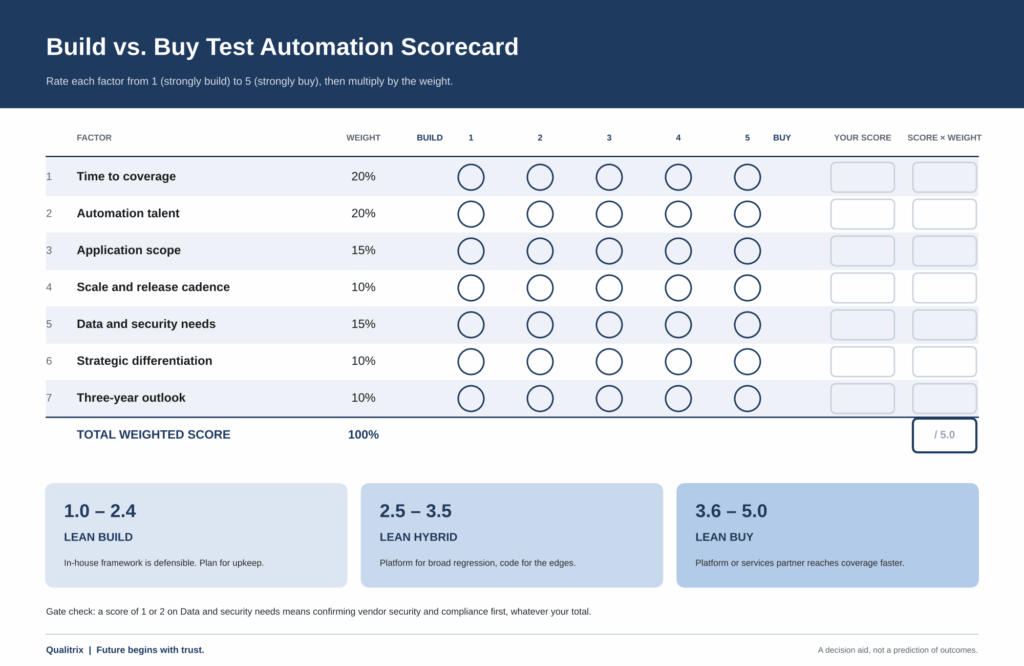
If you score mostly in the left column, building is defensible. Mostly right, buy. A split result points to a hybrid, with the platform covering broad regression and custom code reserved for the edges.
Price comparisons at the start of a project tend to mislead. A fair three-year model includes:
Model each option at your expected volume in year three, not at pilot scale. Rankings often change when volume grows. Capture your own baseline first, such as regression duration, maintenance hours per sprint, and escaped defects, so you can measure the result rather than assume it.
A leading financial services provider operating in an agile model needed regression coverage for 240 end-to-end user journeys across four distinct products. The conventional route, building automation with senior engineers, was estimated at 50 weeks for two engineers. Meanwhile, daily deployments were delayed by 16+ hours of QA time, and frequent script breakage created heavy maintenance overhead.
The client used Nogrunt, Qualitrix’s agentic, AI-led quality engineering platform. The results were measurable:
| Metric | Conventional estimate or baseline | With Nogrunt |
| Time to build the suite | 50 weeks (estimated) | 8 weeks |
| QA time per deployment | 16+ hours | About 2 hours |
| One-time automation cost | $105,000 | $10,000 |
| Time to full coverage | Baseline | 6x faster |
The existing team built the suite without dedicated senior automation engineers, and self-healing scripts optimized for CI/CD kept tests stable as the application changed. The client also saw return on investment from day one, through reduced rework and steadier release velocity. Read the full hyper-speed regression automation case study for details.
Note that the 50-week figure was an estimate of the conventional route, not a completed in-house build, so it illustrates the scale of the trade-off rather than a head-to-head result. The pattern it shows is still useful: where talent and time are the constraints, a platform can change the economics substantially.
For most enterprises, the practical answer is neither pure build nor pure buy. A hybrid approach uses a platform for broad, repeatable regression and keeps custom code for the areas where precision matters: complex calculations, specialized integrations, and performance or security testing.
A hybrid model works best when ownership is clear. Decide which layer each team owns, document where custom code plugs into the platform, and review the balance every six months. If the custom layer keeps growing, reassess whether the platform fits. If it stays small, the platform is doing its job.
Whichever route you choose, AI-generated tests need human oversight. A script can run perfectly and still validate the wrong behavior. At Qualitrix, we treat this through the Testing & Validation dimension of our T.R.U.S.T. Framework: AI-assisted generation, combined with human review of test intent, expected results, and coverage of risk. Speed matters, but only trustworthy tests produce trustworthy releases.
Many teams discover that the real constraint is not the tool but the capacity to adopt it. A specialist automation testing service can bridge that gap by setting up frameworks or platforms, building the first wave of tests, wiring pipelines, and training your staff.
Consider test automation services when:
When selecting a partner, ask how it builds for maintainability, how it validates AI-generated output, how test data and credentials are protected, and what measurable outcomes it has delivered on comparable programs. A good provider helps you decide what to build, what to buy, and what to keep, rather than defaulting to its own preferred tool.
The build-versus-buy question rarely has a universal answer. It depends on your talent, your application landscape, your regulatory environment, and how long you expect to own the capability. Score the seven factors honestly, model three years of cost, and start with a pilot that measures real results.
The organizations that succeed treat test automation as a long-term engineering discipline, not a one-time purchase or project. They choose the model that lets their teams release faster and with greater confidence.
Deciding between a framework and a platform? Talk to Qualitrix about QA automation services, a platform pilot, or a hybrid approach built around your applications and release cadence.
Build vs. buy in AI is the decision between developing an AI capability in-house, with your own team, infrastructure, and code, or purchasing a ready-made solution from a vendor. A third option, a hybrid, combines both: you buy the commodity layer and build only what is specific to your business. In test automation, building usually means assembling an in-house framework, while buying means adopting an AI-powered platform. The right choice depends on your talent, timeline, data sensitivity, scale, and how strategic the capability is.
Building makes sense when your application scope is narrow, such as a single web application, and you have experienced automation engineers who can own the framework long term. It also fits when testing is a strategic engineering asset or when strict data-control requirements limit vendor options. Plan for ongoing costs beyond the first scripts, including infrastructure, integrations, test data, and maintenance. If any of those lack a named owner, the cost of building is likely being underestimated.
Compare them over three years, not at launch. A framework carries costs for people, infrastructure, integrations, and test maintenance. A platform carries licensing, which can rise with usage, plus training and possible exit costs. Model both at your expected year-three volume. In our financial services case study, building the suite conventionally was estimated at 50 weeks for two senior engineers and $105,000. With Nogrunt, the existing team finished in 8 weeks, and the one-time cost was $10,000. Treat the conventional figures as an estimate, not a completed build.
A hybrid approach uses an AI-powered platform for broad, repeatable regression and keeps custom code for areas that need precision, such as complex calculations, specialized integrations, and performance or security testing. It works best when ownership is clear: each team knows which layer it maintains and where custom code plugs into the platform. Review the balance every six months. If the custom layer keeps growing, reassess whether the platform fits.
Test automation services make sense when the constraint is capacity or skills, not the choice of tool. Typical signs include regression that delays releases, a growing backlog of manual cases, difficulty hiring senior automation engineers, or a platform pilot that needs structure. A good QA automation services partner builds or configures the framework or platform, creates the first wave of tests, connects the pipeline, trains your team, and helps you decide what to build and what to buy. Ask how it validates AI-generated tests and protects test data.

Future Begins With Trust
A 30-minute conversation with an engineer who has done this before — not a sales call. We will tell you what we would do differently, whether or not you work with us.