
Services · Test Automation
Test Automation Services
for Enterprise QA Teams
Automation testing services built around your stack and your pipeline: web, mobile, API and performance, delivered by engineers who have done it before.
40%
Shorter regression cycles.
NBFC lending platform · Tricentis Tosca
300+
Unattended regression cycles, zero defects escaped to production.
Continuous delivery programme
1,500+
Test cases per cycle, regression time down 40%.
Global SaaS platform
Coverage
What we automate
Six surfaces, one framework. Each runs in your pipeline and reports into the same place.
Web
Parallel browser suites
Selenium, Selenide and Playwright suites that run in parallel across browsers, so a full cross-browser pass finishes in the time a single-threaded run takes for one.
Mobile
Android and iOS
Appium suites covering both platforms from one test design, executed on real devices or a cloud device farm.
API
Service-layer coverage
RestAssured and Postman suites wired into CI.
Performance
Load and resilience
Load, stress, spike, soak and scalability testing.
Cloud and CI/CD
Every build, every night
Smoke tests on every build and nightly regression with results each morning.
Salesforce
No-code, auto-healing
No-code, auto-healing automation with Salesforce accelerators.
Architecture
The test automation framework we build
A test automation framework is not a pile of scripts. It is a layered system, and the layers decide whether the suite is still running a year from now or quietly switched off.
trigger
- Run history
- Failure classification
- Screenshots and traces
- Coverage dashboard
- Cycle-time trend
Layered test design
Test intent, page objects, business components and utilities live in separate layers. A UI change touches one file, not forty.
Externalised test data
Data sits outside the tests and is environment-aware. In regulated environments we use masked or synthetic data, so no production record enters a run.
Environment configuration
One suite runs against dev, QA, staging or production-like through configuration alone. No branches, no commented-out URLs.
Parallel execution
Tests are written to be independent, so they run in parallel across browsers, devices and containers. This is what turns a six-hour pass into forty minutes.
Reporting and evidence
Run history, failure classification, and screenshots, logs and traces captured at the point of failure.
Flake control
Explicit waits rather than sleeps, a defined retry policy, and a quarantine lane, so one unstable script cannot block a release.
Version control and review
The suite lives in your repository and is reviewed like product code. Your engineers can read it, change it and own it.
Pipeline integration
Execution is a pipeline job, not a person running a batch file. Triggers, scheduling, artefacts and notifications configured as part of delivery.
Method
How we work
Three phases, each ending in something you can hold, not a status update.
Phase 01
Assess and blueprint
Typically 2 to 4 weeks
Assess
We map your regression suite, risk areas and release cadence.
Candidate list + business caseFramework
We pick tools for your stack, favouring codeless and open-source options so you are not locked in.
Framework blueprintPhase 02
Implement and integrate
Typically 6 to 14 weeks
Build
Reusable scripts, with test data handled for privacy and compliance.
Automated suitesCI/CD setup
Execution becomes a pipeline job. Triggers, scheduling, parallel runners, artefact storage and failure notifications go into the channel your team already watches.
Pipeline jobs and reportsPhase 03
Measure and evolve
Ongoing
Maintain
Auto-healing and impact analysis keep the suite current as the product changes.
Coverage and cycle-time reportingScale
Automation expands, ranked by risk and reuse scores.
Expanded coverageDeliverables
What you get
Everything below is handed over and is yours, whether or not the engagement continues.
Candidate list and business case
Every flow ranked by risk and reuse, with estimated effort saved per cycle.
Framework blueprint
Tooling decisions, architecture and conventions, written down before code is cut.
Automated test suites
In your repository and your version control, readable and changeable by your engineers.
Pipeline jobs
Configured in your CI, with triggers, schedules and notifications documented.
Coverage reporting
A live view of what is covered, what is failing, and how long the suite takes to run.
Runbook and handover
How to run it, extend it, debug a failure and onboard a new engineer.
Test data strategy
How data is generated, masked and refreshed, with the compliance position stated.
Full IP ownership
Framework, scripts and documentation are yours. No licence, no dependency on us.
Tooling
Test automation tools and frameworks we use
We choose automation testing tools for your stack and your budget. Codeless and open-source options come first, so you are not locked into one vendor.

Tricentis Tosca
Model-based, codeless automation for large enterprise estates such as SAP, Salesforce, core banking and packaged applications where the UI is generated rather than hand-built. We pick Tosca when non-developer testers need to own automation, or when risk-based test selection matters more than raw execution speed.

Selenium & Selenide
The open-source baseline for browser automation, and still the right answer when a team wants maximum control at zero licence cost. Selenide adds a concise API and smarter waiting on top of Selenium, removing most of the boilerplate and a good share of the flakiness.

Playwright
Our default for new web automation. Auto-waiting, network interception and trace-based debugging cut flakiness substantially, and parallel execution is built in rather than bolted on. Strongest fit for modern single-page applications.

Appium
Mobile automation for Android and iOS from one test design, running on real devices, emulators or a cloud device farm. Device coverage (which models, which OS versions, how often) is agreed during the blueprint phase rather than discovered later.

RestAssured & Postman
Service-layer testing, where automation returns the most time per test written. API tests run in seconds rather than minutes, break for clearer reasons than UI tests, and catch contract problems before anything is built on top of them.

Jenkins
Pipeline orchestration, with smoke tests on every build, scheduled nightly regression, parallel runners and artefact storage. We work in whatever CI you already run; the point is that execution is owned by the pipeline, not by a person remembering to start it.

BDD (Cucumber-style)
A specification layer, used when business analysts or product owners need to read and contribute to test scenarios. It earns its overhead where requirements must be traceable to a named test, and costs more than it returns where the only readers are engineers.
Already running a framework? We extend it rather than replace it.
Selection
Which test automation tool fits your situation
The honest version of “we choose the tool for your stack”. This is roughly how the conversation goes in a scoping call.
| If this is your situation | We usually recommend | Why |
|---|---|---|
| Modern single-page web app, engineering-led team | Playwright | Auto-waiting and tracing cut flakiness; parallel and cross-browser support are native. |
| Large packaged-application estate, such as SAP, Salesforce or core banking | Tricentis Tosca | Model-based and codeless, so non-developer testers can own it; risk-based selection narrows each run. |
| In-house Java team who will take the suite over | Selenium with Selenide | No licence cost, total control, and a skill set the team already has. |
| Product shipping on both Android and iOS | Appium | One test design covers both platforms, on real devices or a cloud farm. |
| UI tests that exist only to check backend behaviour | RestAssured or Postman | Seconds instead of minutes per test, clearer failures, breaks caught before the UI is involved. |
| Requirements that must be traceable to named tests | BDD layer on top of the above | Business-readable scenarios map to specific tests for audit and sign-off. |
| Fast-changing product where maintenance is the bottleneck | Nogrunt | Scripts self-heal on product change; impact analysis narrows each run to affected flows. |
| Small team, no automation specialist, coverage needed soon | Codeless, managed by us | Coverage starts returning time in weeks without hiring, under a Managed Services model. |
Platforms
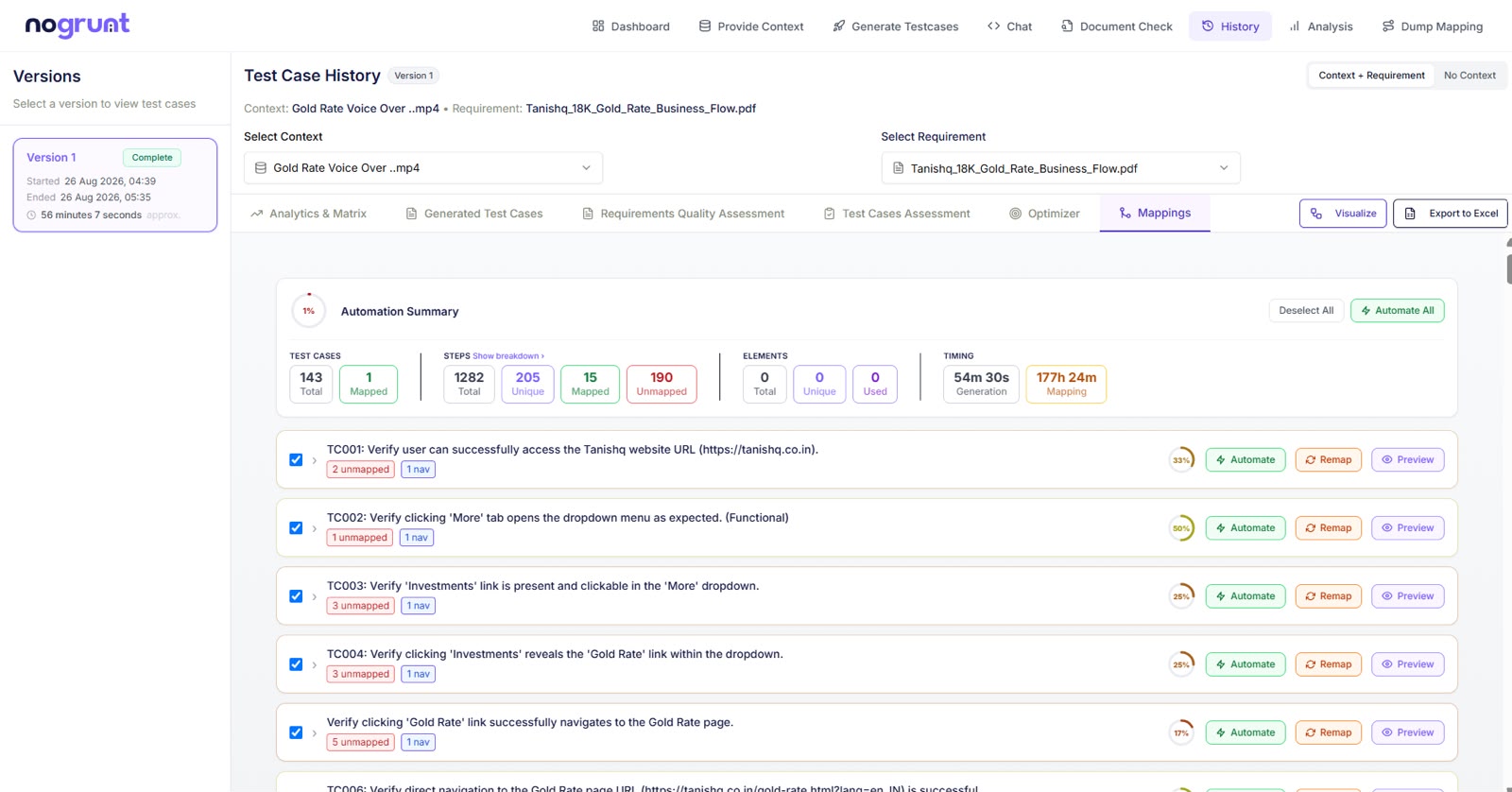
Nogrunt. Built on Gen AI, maintained without the grunt work.
A Gen AI test automation platform from the Qualitrix solutions family.
- Agentic test execution at scale
- Scripts heal automatically when the product changes
- Change-impact visibility, which flows a given change affects
- Plugs into your existing CI/CD pipeline
Takeover
Taking over a stalled test automation framework
Most teams who come to us are not starting from zero. They have a suite that someone built, that nobody now maintains, and that the release process has quietly stopped trusting.
Step 01
Audit what exists
Four numbers decide everything that follows: real coverage of critical flows, flake rate, full-suite run time, and how long it takes to add one new test. We also check dependency currency, because a suite pinned to an unsupported driver is a rebuild whatever else is true.
Step 02
Stabilise before extending
Flaky tests get fixed or quarantined first. There is no value in adding coverage to a suite nobody believes, and a red build that gets ignored is worse than no build at all.
Step 03
Extend or rebuild, with reasons
We put the recommendation in writing with the evidence behind it. Most clients keep a substantial part of their existing suite, usually the API layer and the stable core journeys, so the earlier investment is not written off.
Proof
Test automation results from our engagements

Lending
A leading NBFC cut regression cycle time by 40%
Regression across loan products automated with Tricentis Tosca and integrated with CI/CD. Over 300 unattended regression cycles.
Read the case study

Banking · In progress
A leading private bank is targeting 2-day regression instead of 10
AI agents and Playwright moving the Cash Management Module to impact-based testing. Engagement in progress; the two-day figure is the target, not a result.
Read the case study
Measurement
What we report, and what we hold ourselves to
Automation programmes fail quietly. These are the numbers that make that impossible, reported every cycle from the first release onward.
Automation coverage
Share of critical user journeys covered, not a raw test count. A thousand tests over one flow is not coverage.
Regression cycle time
Wall-clock time for a full pass, release over release. The number that decides how often you can ship.
Flake rate
Share of failures that are the test's fault, not the product's. The best single predictor of whether a suite survives.
Defect escape rate
Defects found in production the suite should have caught. The only measure of whether automation is working.
Mean time to repair
How long a failing script stays broken. Rises fast when a framework is badly layered.
Manual effort displaced
Tester-hours per cycle no longer spent re-checking the same flows. The basis of the ROI calculation.
Commercials
Four ways to engage us
Cost depends on how many applications, how many test cases and which environments you run. The model decides how that cost behaves: fixed, flexed, or tied to an outcome.
Model 01
Professional Services
Fixed scope, fixed outcome. You define what needs automating, we build it and hand it over. The right model for a first automation build, a tool migration, or a defined piece of work with a clear finish line.
Model 02
Managed Capacity
A dedicated squad working to your backlog, your priorities and your tooling. You direct the work; we hold the team, the hiring and the continuity. The right model when scope changes month to month.
Model 03
Managed Services
We own the outcome against agreed service levels (coverage, cycle time, defect escape rate) rather than hours delivered. You stop managing testers and start reading a report.
Model 04
Testing Centre of Excellence
Standards, tooling and governance stood up across several product teams, then run by us or transferred to you. The right model where QA is fragmented across business units.
By industry
Built for industries where failure is expensive.
Every sector answers to someone different. We build the test evidence each one expects.
Financial services
Lending, digital banking and payments platforms where one release can touch every product.
AI platforms
Model-backed products where behaviour shifts between versions and regression has no fixed expected output.
Technology, media and telecom
High-traffic apps and streaming platforms that cannot afford slow releases.
Retail and consumer
Storefronts and order systems where peak trading days leave no window for a bad release.
Healthcare and life sciences
Regulated software where every release needs repeatable evidence.
Public sector
Citizen-facing services with accessibility obligations and load that arrives in spikes.
FAQ
Frequently asked questions
Common questions from teams scoping a test automation engagement.
Ask us something elseWhat are test automation services?
Test automation services hand the repetitive part of testing to a specialist team and its tooling. We assess your product, design a framework, script the tests, run them in your pipeline and report defects, so your engineers stop re-checking the same flows by hand before every release.
How much do test automation services cost?
Cost depends on how many applications, how many test cases and which environments you run. We price through one of four engagement models, from a fixed-scope project to a dedicated team. A 30-minute scoping call is enough for us to recommend a model and give you a range.
Which test automation tools do you work with?
We choose the tool for your stack instead of forcing one. Our engineers work across the open-source and commercial tools listed above, covering web, mobile and API testing. If you already run a framework, we can extend it instead of replacing it.
How long before automation pays for itself?
It depends on how often you release and how much regression testing you repeat today. Frequent releases pay back sooner. In our NBFC engagement, automation cut regression effort by 40%. We will estimate your payback period during scoping, using your own release cadence and test case counts.
Should we automate every test?
No. Automate stable, repetitive, high-value flows such as regression, smoke and data-heavy checks. Keep exploratory testing, new features still in flux and one-off checks manual. A good plan ranks test cases by risk and reuse first, then automates in that order.
Can you take over our existing automation framework?
Yes. We first audit what you have: coverage, flaky tests, run time and maintainability. Then we either stabilize and extend the framework or propose a rebuild with reasons. Most clients keep part of their existing suite, so the earlier investment is not lost.
How long does a test automation implementation take?
Assessment and framework design typically run two to four weeks. The first automated suites are usually running in your pipeline six to fourteen weeks after that, depending on application count and environment complexity. Coverage returns time before the full suite is finished, because suites are wired into CI as they land rather than at the end.
Who owns the test code and the intellectual property?
You do. The framework, the scripts, the pipeline configuration and the documentation are delivered into your repository and are yours to keep, extend or hand to another vendor. There is no licence on the framework and no dependency on us to keep running it.
How do you handle test data in regulated environments?
Test data sits outside the test code and is masked or synthetically generated, so production records never enter a test run. The approach is agreed during the blueprint phase and documented as part of handover, which is what an auditor will ask to see.
How do you deal with flaky tests?
Flakiness is treated as a defect in the suite, not an acceptable cost. We use explicit waits rather than fixed sleeps, a defined retry policy, and a quarantine lane so an unstable test is isolated rather than blocking a release. Flake rate is reported every cycle, because a team that learns to ignore red builds has lost the value of the suite entirely.
Do you work inside our CI, or your own?
Yours. Execution becomes a job in the pipeline you already run, whether that is Jenkins, GitHub Actions, GitLab, Azure DevOps or another, with triggers, scheduling, parallel runners and notifications configured as part of delivery. We do not ask clients to adopt a separate execution platform.
Can you work alongside our in-house QA team?
Yes, and in most engagements we do. A common pattern is that our engineers build and maintain the regression suite while your team keeps exploratory testing and new-feature work. Under Managed Capacity the squad works directly to your backlog and your priorities.
Do you cover mobile device testing?
Yes. Appium suites run on real devices, emulators or a cloud device farm. Which device models and OS versions to cover, and how often, is a decision we make with you during the blueprint phase, based on your own analytics rather than a generic matrix.
What happens to the suite when our product changes?
That is what Phase 03 is for. Layered design means a UI change touches one file rather than many; impact analysis identifies which tests a given change affects; and on Nogrunt engagements, scripts heal themselves when the product changes. Maintenance is scoped into the engagement rather than treated as an unplanned cost.
What should I look for in a provider for test automation framework setup?
Look for a layered framework, where a UI change touches one file instead of forty. Test data should sit outside the tests (masked or synthetic in regulated environments), one suite should run across every environment, and flaky tests should have a defined policy. Execution should run as a job in your own CI, with the code in your repository. Most importantly, you should own the framework, scripts and documentation. At Qualitrix, the framework blueprint is written down before any code is cut.
Can your test automation scale across multiple domains and product teams?
Yes. Web, mobile, API, performance, CI/CD and Salesforce all run on one framework and report into the same place, so adding a domain doesn’t mean starting again. Independent tests run in parallel across browsers, devices and containers, which keeps cycle times down as coverage grows. Where QA is split across business units, our Testing Centre of Excellence puts shared standards and governance in place, then runs it for you or hands it over.
Future begins with trust
Tell us what is slowing your releases down.
Book a 30-minute conversation with an engineer. We will look at your current testing, name the first flows worth automating and suggest an engagement model.
Awards and Recognition
-

Major Contender in its Quality Engineering (QE) Services for AI Applications and Systems PEAK Matrix® Assessment 2026.
-

PAC QE Radar
Rated “Excellent” -

World AI Summit AI Validation & Testing
Excellence 2025 -
Everest Group PEAK Matrix®
Major Contender QE Specialist Services 2025 -

Positioned in NelsonHall
Crowdtesting assessment of IT services firms for 2021