General
Test Automation vs. Continuous Monitoring: You Probably Need Both

Picture a sale day at a large retailer. The release went out cleanly last week, and every automated test passed. Then, at 9 p.m., a customer sees a promotional price on the mobile app that does not match the website. Another sees a product marked “in stock” that left the warehouse days ago.
Nothing was deployed today, so no test ran. Nothing in the code was wrong, either. A pricing feed lagged, an inventory sync drifted, and the problem went live unnoticed.
This is the gap between two disciplines that are often lumped together, test automation and continuous monitoring. They sound similar, and they both involve machines checking things so people do not have to. But they answer different questions, and treating them as interchangeable leaves a blind spot that customers tend to find before you do.
Test automation uses scripts and tools to verify that software behaves as expected without a person clicking through every scenario. Teams run these checks when something changes: a developer commits code, a build completes, or a release candidate is ready.
The value of test automation is speed and repeatability. A regression suite that takes a team of testers two days can run in an hour every time, with the same rigor. That is why test automation became the backbone of delivery pipelines. It lets teams release often without breaking what already works.
Automation testing is best at answering one question: “Is this release safe?”
It excels at:
But test automation has a built-in limitation. It runs when you trigger it, and it tests what you thought to test. It is a gate at a moment in time.
Continuous monitoring checks the environment on an ongoing basis to see whether or not anything has been deployed. When asking whether a release is safe, it asks: “Is the business working right now?”
In practice, that means running checks against production on a schedule:
Monitoring catches the problems that live in the spaces between systems: data feeds that fail quietly, integrations that time out under load, content updates that introduce errors, and configuration changes made outside the release process. None of these show up in a pre‑release test because none of them are caused by a release.
| Test automation | Continuous monitoring | |
| When it runs | On change (build, release, deployment) | Always, on a schedule or in real time |
| Where it runs | Mostly pre-production | Production |
| What it catches | Defects introduced by code changes | Data drift, integration failures, outages, content errors |
| Core question | “Is this release safe?” | “Is the business working right now?” |
| Failure it prevents | Shipping a broken feature | Living with a broken experience unnoticed |
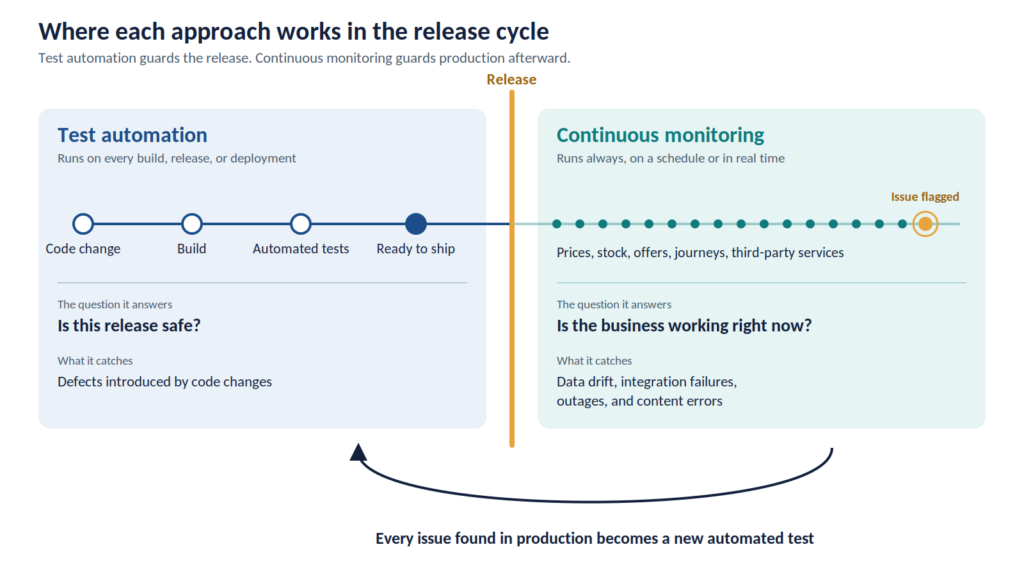
The shorthand: test automation protects you before release, and continuous monitoring protects you after it.
A passing test suite tells you the software worked under the conditions you simulated. It says nothing about what happens when a supplier feed arrives late, when a promotion is loaded with the wrong date range, or when a downstream service slows down on your day.
Retail is especially exposed here because so much of what customers see is driven by data rather than code. Prices, stock levels, offers, and product content change constantly without a deployment. If your only safety net is automated testing tied to releases, all of that change happens unchecked.
The reverse is just as risky. A team that relies on production monitoring will learn about defects only after they have gone live. Alerts can be fast. Fast still means customers already saw the problem.
Without a base of automated testing, monitoring also becomes noisy. Teams end up chasing issues that a regression suite would have stopped in a build pipeline for a fraction of the cost.
The strongest quality programs treat these as two halves of one system. Automation reduces the number of defects that reach production. Monitoring catches what slips through or emerges afterward. And every incident monitoring finds becomes a test case so the automated suite gets smarter over time.
This is where the conversation is changing. Traditional automation depends on people writing, maintaining, and updating scripts, and maintenance is often where the real cost hides. Every UI change can break a test, and teams end up spending more time repairing scripts than finding defects.
AI-led test automation shifts some of that burden. Done well, it can:
AI is not a substitute for knowing your business. It can be seen that the price looks odd. A human still needs to decide what “correct” means for a specific promotion. The best results come from pairing AI-led capabilities with rules, sensible ownership, and people who understand the retail context.
Notably, AI strengthens both disciplines. It makes test automation less brittle. It makes monitoring smarter and quieter. That is one reason to think of them together.
Few environments show the value of combining both approaches as clearly as large-scale retail. Titan Company Limited runs a wide portfolio of digital applications, e-commerce websites, and point-of-sale workflows, where gold prices, inventory levels, and customer journeys all have to be accurate at any given moment.
Before automation, Titan’s teams relied on recurring manual checks to validate applications, customer journeys, pricing, and inventory. With gold prices and stock levels shifting frequently, periodic reviews struggled to keep customer-facing information current, and issues between validation cycles could go unnoticed.
Qualitrix closed that gap with Nogrunt, its agentic test automation platform, pairing automation with monitoring. More than 250 scenarios were automated across Titan’s US and UAE e-commerce websites in staging and production, while six applications came under continuous validation, including gold prices and inventory.
The automated runs also caught real defects, such as products showing as unavailable despite being in stock and filter-count mismatches. Problems like these show why checks need to run continuously in production, not only at release.
The result was broader coverage, fewer blind spots, and a faster path from a broken check to an investigated issue, with a lighter manual load for QA teams. The lesson is not any single tool. It is the shift from asking “Did we test the release?” to ask “Is what customers see right now correct?”
Not every product needs this level of coverage. A simple internal tool that changes rarely may be well served by automation alone. But you probably need both if several of these apply to you:
If you nodded at three or more a release-only testing approach is likely leaving real exposure.
You do not need to build everything at once. A practical path looks like this:
In the Titan engagement, this meant continuously validating gold prices and inventory across six applications with automated reports and email alerts giving Titan’s teams visibility into failures.
Test automation and continuous monitoring are not competitors. Test automation keeps changes out of production, and continuous monitoring keeps production honest after the change. Teams that rely on one are betting that nothing will go wrong in the part they are not watching.
As catalogs, channels, and customer expectations grow, quality becomes a state rather than a gate at release. Automated testing builds confidence in what you ship, monitoring builds confidence in what customers see, and AI-led test automation reduces maintenance and noise, on both sides.
In short, let test automation guard every release, let continuous monitoring watch everything in between, and let each feed the other so you catch prices and stale stock before your customers do.
Ready to move beyond checks? Contact Qualitrix to talk through your quality strategy. See how test automation and continuous monitoring can work for your team.
Test automation runs scripted checks whenever something changes, such as a build or release, to confirm the change is safe. Continuous monitoring runs checks against the live environment all the time to confirm the business is working right now. In short, one protects you before release, and the other protects you after it.
No. Monitoring finds problems after customers may have already seen them, while automated testing stops many defects from reaching production at all. Without a solid base of automated testing, monitoring also becomes noisy, because it ends up catching issues a regression suite would have stopped earlier.
AI-led test automation uses AI to help create, prioritize, and maintain tests. For example, it can self-heal a script when a page element changes or choose which tests to run based on what changed in a release. Traditional automation testing relies on people to write and update every script by hand, and a person still has to define what “correct” means.
Most teams start by automating the stable, repeatable checks, such as search, cart, and checkout regression. Then they add monitoring for what changes without a release, like prices, inventory, content, and third-party services. If wrong prices or stock errors are already reaching customers, put monitoring on those first.
You probably need both if prices, stock, or promotions change daily, you run several channels that must stay consistent, or you depend on external data feeds. The same is true if peak sales events carry outsized revenue, or if customers are usually the first to report problems. If three or more of these apply, a release-only testing approach likely leaves real exposure.

Future Begins With Trust
A 30-minute conversation with an engineer who has done this before — not a sales call. We will tell you what we would do differently, whether or not you work with us.